Built for founders running DTC retention, creative and performance marketing agencies between $500k and $3M. You've crossed the early scaling line, your team has grown, and every senior decision still routes back to you. Hiring more people won't fix it. Here's what needs to change first.
















Six structural shifts that come up in nearly every agency I've operated alongside between $500k and $3M. Skim the outline, then jump to whichever one is hitting you hardest right now.
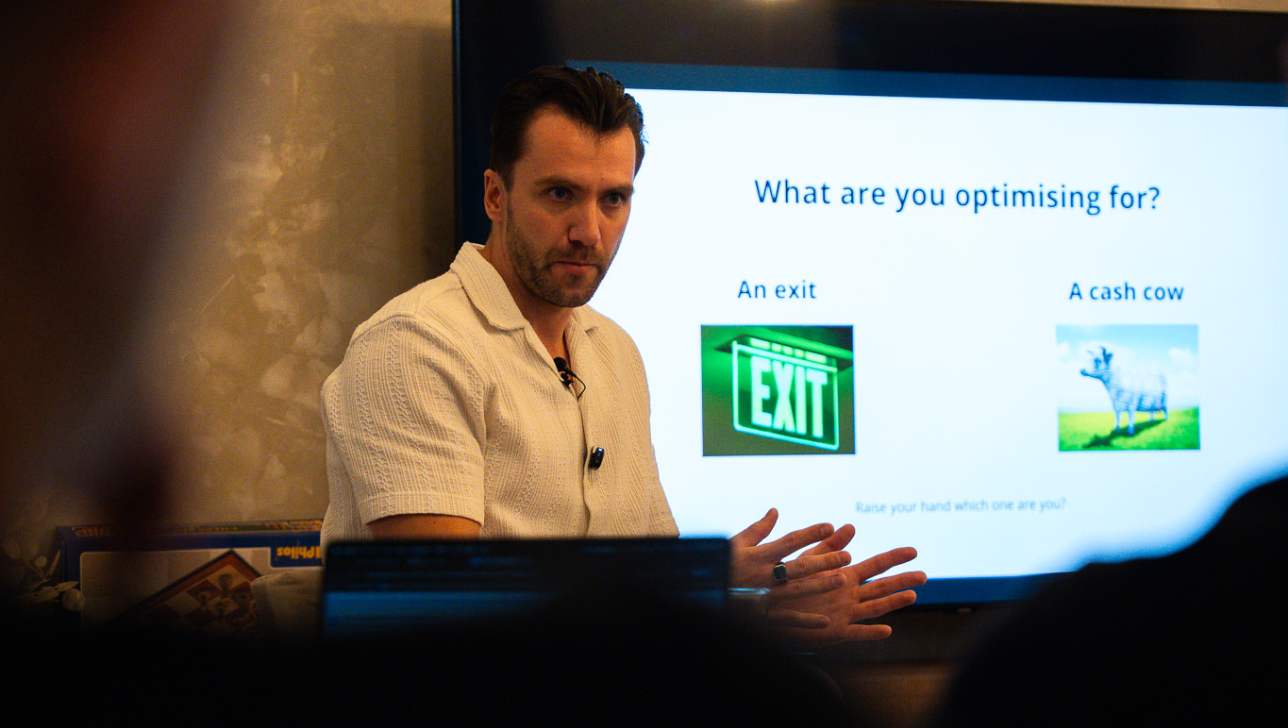
Before any of this matters, you have to answer one question, and most founders don't. Are you building a lifestyle agency or an 8-figure one? It's a different game depending on which one you pick, and it's a different operating model underneath.
If a lifestyle agency at $2-3M with strong margins is the goal, that's a great life. You stay close to the work, keep the team small, and don't bother with leadership layers, weekly L10s, or 5-stage hiring loops. None of it makes sense at that scale, and trying to retrofit it usually erodes the margin you're working so hard to protect.
If 8 figures is the goal, the wiring is different - different mindset, different team, different operating model, different relationship with your own time. The thing that got you to $2M won't get you to $10M, and trying to do it on the same chassis is what burns most founders out somewhere around $5M.
If you haven't sat with this question, do yourself a favour and don't keep building until you have. The goal can shift later as things change, that's fine, that's normal. But what I see keep founders genuinely stuck is they never crystallise the answer in the first place. Without that clarity, every distraction starts to look viable - new service lines, new ventures, partnerships, AI side bets, shiny opportunities - and they all start stealing your time because there's nothing central for them to compete with. Get clear on what you actually want to build, and the noes get easier to say.
Most agencies under $5M run on two layers, with the founder at the top and everyone else flat underneath. You can take that shape up to $300-$400k/mo on sheer effort, but after that the founder becomes the bottleneck for every cross-functional decision and the operating model starts breaking under its own weight.
The agencies that scale past $400k/mo are usually running five distinct layers, and there's one specific layer between the founder and the function heads that almost nobody builds. It's the one that fixes everything else. I'll come back to it in the next section.
It's drastically rare for me to walk into an agency and find an experienced operator sitting in the COO or Head of Ops seat. What I usually find instead is a project manager or an HR admin who got promoted into the role because the founder wanted to "buy back time", and the closest senior person available was the one already running the calendar. It almost never works the way the founder hoped, because you don't solve a strategic bottleneck with a tactical hire.
The project-manager-style COO is excellent at maintaining order, ticking off checkboxes, and keeping the operating cadence alive. That's genuinely useful work, and at smaller scale it's enough. The problem is that the role you actually need at $400k/mo and beyond is doing three things this profile is rarely equipped to do:
When you put a glorified project manager into a strategic seat, what you end up doing is managing the present rather than building the future, and the agency starts to feel like it's running smoothly while it caps out at the same revenue ceiling for two years running.
Makes the business feel organised. Doesn't make it more effective. The founder is still the escalation point. Decisions still flow upwards.
Builds the future while running the present. Pulls escalations off the founder's desk and stops them at the operating layer.
The first is hiring an experienced operator who has already taken an agency to $5M+ in their last role. They've made the structural mistakes once already, on someone else's watch, and you get to skip the 18 months of figuring it out the hard way. The second is identifying a high-agency specialist with a real track record of building scalable systems even if they haven't held the COO title before. They're faster to spot if you know what you're looking for, slightly higher risk, and you pay for the performance you can verify rather than the pedigree on the CV.
The default to avoid is the project manager or HR admin you promote because they're already on the team and the move feels easy. That hire usually costs you 18 months and somewhere between $60k-$90k of fully-loaded mis-hire cost, and you end up back here making the same hire properly the second time round.
The instinct most founders have when they realise their team isn't operating independently enough is to invest in levelling them up - more training, more exposure, more context, more leadership development for the senior layer. This is a reasonable instinct, and it's also the reason most agencies stay stuck for years even with a genuinely strong team underneath the founder.
The reason it fails is that ownership and skill are not the same transfer. Your team can develop skills at a real pace while still defaulting to escalating decisions back to you. In fact they often develop skills faster when you're in the room, because they learn by watching your judgement happen in real time, which feels productive but reinforces the exact dependency you were trying to fix.
The actual problem isn't capability, it's that judgement under uncertainty requires consequence. As long as you're standing behind the team as the backstop, they never feel the full weight of a bad call. They never stare at a hiring mistake that cost the business $60k. They never sit across the table from a client who's losing their mind, with no senior person above them to clean it up. Without that consequence, there's no real ownership being transferred, only delegation with training wheels still attached.
You can't simulate consequences in advance, you can only step back and let them happen. Which feels, to most founders I work with, like lowering standards or inviting disorder, when actually it's the only mechanism that ever produces a senior team that can run without you.
If you strip the agency back to first principles, what you're really running is a machine that turns client context, market information, internal processes, and team judgement into outcomes. AI becomes genuinely useful inside that machine only when four foundations are sitting underneath it:
Without those four sitting in place, AI behaves like an intelligent freelancer with no memory of your business, and you spend more time prompting it than actually getting leverage from it. With them in place, it starts to behave like an operating layer for the business itself. The pattern YC-backed workflow companies are increasingly converging on is the same idea - a context engine that ingests internal signals, understands the work in progress, and routes tasks between people and agents based on what each is best at.
The reason data quality matters so much is that AI quality is downstream of context quality. If you want reliable AI output across account strategy, reporting, client communication, and SOP enforcement, the AI needs to be working with your real notes, your real documents, and your real activity history. Generic internet knowledge isn't going to get you anywhere close to the output an agency operator actually needs.
The YC argument for AI-native agencies is worth understanding even if you ignore everything else in this section. Agencies have historically been hard to scale because margins are low and growth almost always requires more people. AI changes that equation by letting software replace headcount inside the agency for the right kinds of work, which means delivery gets cheaper and margins start looking less like a services business and more like a SaaS one. Whether you find that compelling or not, the founders who build for it now will be operating at structurally better margins than the ones who don't, three years from here.
What I see most agencies running on right now is the Dependency Model on the left, with the founder sitting at the bottom of the stack and holding all the weight of the business on their shoulders. The Leverage Model flips that completely - the founder becomes the architect at the top, and data, AI, and systems become the operating layer that supports people, delivery, and operations underneath.
Traditional agencies are built on founder dependency. The AI-native ones being built right now are built on data, systems, and leverage, and that's the structural shift the next few years are going to be defined by.
You can build the org chart, hire the right COO, install the data and AI layer underneath, and put every system from this blueprint in place. None of it actually holds together if you don't make the identity shift underneath all of it, and that's the part of this work I find founders consistently underestimate.
What I see happen when this shift doesn't fully land is that founders build the structure on paper but keep operating like the founder underneath it. They hire the COO and then keep being the COO. They install the systems and then keep doing the work the systems were meant to handle. That's why the COO eventually leaves, why the senior team keeps escalating, and why the new operating system you spent six months installing decays back into founder-routed decisions within 90 days of going live.
Most agency founders start as operators or technicians. You sell the work, you deliver the work, you manage the team, you put out the fires when something breaks. Your fingerprints end up on every client, every hire, every escalation. That identity - the doer, the firefighter, the one who saves the day when things go sideways - is exactly what gets a business to six and sometimes seven figures, and exactly what stops it from growing past that line.
At scale, the founder's job stops being to do. It has to become something different. What I'd call a Leader CEO, whose role is to set direction, allocate resources, and create the conditions where the rest of the team can actually run the day-to-day work without needing you in the room for every decision.
The irony in this work is that you might genuinely think you're at 8/10 right now when you look at your operations, your systems, and your people. Maybe 80% of the business looks fine on paper today. But if I were to remove you from the agency for two full weeks, or even just five working days, that score would almost certainly drop to 2/10 by the end of it. The 8/10 picture isn't an honest read of the operating model itself, it's a read of what you, personally, are holding together with your own bandwidth.
The founder who keeps clinging to operator identity caps the agency at a hustle business indefinitely. You stay perpetually busy chasing new clients, leaning on outbound or content to plug churn, scrambling to patch delivery issues that keep resurfacing because nothing structural ever gets built underneath the actual work.
The founder who genuinely steps into the Leader CEO role starts designing an agency that scales properly. Retention improves because clients stay. Marketing and content start working harder because the back end actually delivers what was sold. Staff turnover drops because the culture stabilises around something other than the founder's energy. Delivery becomes predictable instead of reactive. And growth stops depending on the founder's personal hustle to drag the next quarter into existence.
This is the deepest work in the blueprint and I'm deliberately not going to unpack the whole thing here. The Founder Dependency Audit is where I go into your specific situation - what's actually keeping you stuck in the operating layer, where the dependency is most deeply hidden inside how you're currently spending your time, and what the version of you that runs an 8-figure agency actually looks like operationally and identity-wise.
This blueprint is the surface of the work. The Founder Dependency Audit is where I go deep on your specific agency.
It takes about 4 minutes to complete. You get a structural diagnosis at the end of it, and the chance to decide whether the agency you're currently building is actually the one you want to be running three years from now.
Take the Founder Dependency Audit